Preposition is a small word but very confusing to use in a proper way. Specially when a preposition is paired with different verbs and adjectives. There are many words followed by a particular preposition. It is very difficult to remember which word is correct to use after a particular preposition. In this blog you will find a list of more than 100 words followed by prepositions along with their meanings and uses in sentences.
100+ Words Followed by Prepositions
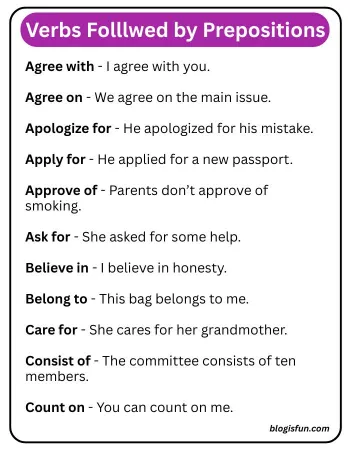
Verbs Followed by Prepositions
Agree with
- I agree with you.
- She never agrees with her brother.
Agree on/about
- We agree on the main issue.
- They argued about the rules.
Apologize for
- He apologized for his mistake.
- She apologized for being late.
Apply for
- He applied for a new passport.
- She applied for the job.
Approve of
- Parents don’t approve of smoking.
- The teacher approved of his plan.
Ask for
- She asked for some help.
- He asked for more time.
Believe in
- I believe in honesty.
- Do you believe in ghosts?
Belong to
- This bag belongs to me.
- That land belongs to the government.
Care for
- She cares for her grandmother.
- Do you care for tea or coffee?
Consist of
- The committee consists of ten members.
- The box consists of books and toys.
Count on
- You can count on me.
- Don’t count on luck.
Depend on
- The result depends on your effort.
- Farmers depend on rain.
Insist on
- He insisted on going out.
- She insisted on her opinion.
Laugh at
- Don’t laugh at others.
- They laughed at his joke.
Listen to
- I am listening to the radio.
- Children should listen to their elders.
Look at
- She is looking at the mirror.
- Please look at the picture.
Look for
- I am looking for my wallet.
- They are looking for a new house.
Look after
- She looks after her brother.
- He looks after the garden.
Object to
- I object to this behavior.
- They objected to the decision.
Participate in
- She participated in the game.
- Many students participated in the contest.
Pay for
- He paid for the drinks.
- I’ll pay for the tickets.
Provide with
- The school provides students with books.
- They provided him with money.
Protect from
- This cream protects skin from sunburn.
- Parents protect children from danger.
Recover from
- He recovered from his illness.
- She recovered from the shock.
Refer to
- He referred to the notes.
- She referred to me as her friend.
Rely on
- Don’t rely on strangers.
- You can rely on me.
Respond to
- He responded to my letter.
- She didn’t respond to the question.
Search for
- The police searched for the thief.
- She searched for her phone.
Succeed in
- He succeeded in solving the puzzle.
- They succeeded in business.
Wait for
- I am waiting for the bus.
- She is waiting for her friend.
Worry about
- Don’t worry about money.
- She worried about her exams.
Think of/about
- He is thinking of his future.
- She thought about the plan.
Work on
- He is working on his homework.
- The scientists worked on the new vaccine.
Deal with
- We must deal with problems calmly.
- She deals with many customers daily.
Dream of
- She dreams of becoming a doctor.
- I dream of traveling the world.
Escape from
- He escaped from prison.
- The dog escaped from the cage.
Focus on
- Please focus on your studies.
- He is focusing on his work.
Graduate from
- She graduated from college last year.
- He graduated from Oxford University.
Hope for
- We hope for success.
- They are hoping for good weather.
Invest in
- He invested money in shares.
- She invested in real estate.
Applaud for
- The audience applauded him for his performance.
- She was applauded for her bravery.
Argue with (person)
- He argued with his friend.
- She is arguing with her neighbor.
Argue about (topic)
- They argued about money.
- Students argued about the new rules.
Borrow from
- I borrowed a book from the library.
- She borrowed some money from her friend.
Lend to
- I lent my pen to him.
- He lent money to his cousin.
Complain about
- She complained about the food.
- He complained about the noise.
Concentrate on
- Please concentrate on your homework.
- He concentrated on the speech.
Confess to
- He confessed to the crime.
- She confessed to her mistake.
Consent to
- She consented to the marriage.
- He consented to the proposal.
Contribute to
- He contributed to the fund.
- She contributed to the project.
Cope with
- She is coping with stress.
- He cannot cope with the pressure.
Die of
- He died of cancer.
- Many people died of hunger.
Die from
- He died from an accident.
- The soldier died from wounds.
Hear of
- Have you heard of this singer?
- I never heard of that city.
Hear from
- I heard from my uncle yesterday.
- We haven’t heard from him in months.
Look forward to
- I look forward to your reply.
- She looks forward to the holidays.
Prevent from
- The guard prevented him from entering.
- The rain prevented us from playing.
Provide for
- He provides for his family.
- Parents must provide for their children.
Recover from
- She recovered from her illness.
- He recovered from the shock.
Shout at
- Don’t shout at children.
- She shouted at her brother.
Smile at
- She smiled at me.
- The baby smiled at the toy.
Specialize in
- He specializes in heart surgery.
- She specializes in interior design.
Suffer from
- He suffers from asthma.
- She is suffering from a cold.
Talk about
- We talked about cricket.
- They talked about their plans.
Talk to
- I talked to my teacher.
- She talked to her parents.
Thank for
- I thanked him for his help.
- She thanked her teacher for the advice.
Translate into
- Translate this passage into English.
- He translated the book into Hindi.
Travel to
- She traveled to London last year.
- He travels to work by train.
Trust in
- We trust in God.
- She trusts in his ability.
Wait on
- The waiter waited on the guests.
- She waited on her sick mother.
Warn about
- The teacher warned us about the test.
- He warned them about the danger.
Work for
- She works for a bank.
- He worked for the company for 10 years.
Work with
- I enjoy working with my team.
- He works with computers.
Write about
- She wrote a story about animals.
- He is writing a book about history.
Write to
- I wrote to my friend yesterday.
- She wrote to the manager.
Adjectives / Participates Followed By Prepositions
Afraid of
- She is afraid of snakes.
- The boy is afraid of the dark.
Angry with (person)
- She is angry with her sister.
- I am angry with him.
Angry at (thing/situation)
- He was angry at the delay.
- She is angry at the news.
Ashamed of
- He is ashamed of his behavior.
- She felt ashamed of lying.
Aware of
- I am aware of the rules.
- Are you aware of the risks?
Bad at
- I am bad at drawing.
- He is bad at spelling.
Capable of
- She is capable of great achievements.
- He is capable of solving it.
Careful of/with
- Be careful of strangers.
- He is careful with money.
Different from
- This book is different from that.
- Your idea is different from mine.
Accustomed to
- He is accustomed to hard work.
- I am not accustomed to spicy food.
Addicted to
- He is addicted to smoking.
- She is addicted to video games.
Amazed at/by
- I was amazed at her performance.
- He was amazed by the news.
Annoyed with (person)
- She was annoyed with her brother.
- He was annoyed with his friends.
Annoyed at (thing/situation)
- She was annoyed at the delay.
- He was annoyed at the noise.
Anxious about
- She is anxious about her exams.
- Parents are anxious about their children.
Anxious for
- We are anxious for your success.
- They were anxious for news.
Curious about
- Children are curious about animals.
- He is curious about space.
Engaged in
- She is engaged in social work.
- He is engaged in writing.
Engaged to
- She is engaged to my cousin.
- He is engaged to a doctor.
Opposed to
- He is opposed to smoking.
- They are opposed to the new rule.
Satisfied with
- She is satisfied with her result.
- He is satisfied with the food.
Shocked at/by
- I was shocked at the news.
- She was shocked by his words.
Surprised at/by
- I was surprised at her kindness.
- They were surprised by the gift.
Upset about/with
- She was upset about the mistake.
- He was upset with his team.
Familiar with
- I am familiar with his work.
- She is familiar with the city.
Famous for
- The city is famous for its culture.
- He is famous for his songs.
Fond of
- She is fond of dancing.
- He is fond of sweets.
Full of
- The bag is full of books.
- The basket is full of fruits.
Good at
- She is good at swimming.
- He is good at solving puzzles.
Guilty of
- He was guilty of theft.
- She is guilty of lying.
Interested in
- She is interested in music.
- He is interested in history.
Jealous of
- She is jealous of her cousin.
- He is jealous of her success.
Kind to
- He is kind to animals.
- She was kind to me.
Married to
- She is married to a doctor.
- He is married to my cousin.
Polite to
- She was polite to the guests.
- He is polite to strangers.
Proud of
- She is proud of her achievements.
- We are proud of our soldiers.
Ready for
- Are you ready for the test?
- She is ready for the journey.
Related to
- This is related to your subject.
- He is related to me.
Responsible for
- Parents are responsible for their children.
- He is responsible for the accident.
Similar to
- Your dress is similar to mine.
- This flower is similar to that.
Sorry for
- I am sorry for my mistake.
- She is sorry for being rude.
Tired of
- She is tired of waiting.
- I am tired of the noise.
Upset with/about
- She is upset with her brother.
- He is upset about his result.
Weak in
- He is weak in mathematics.
- She is weak in English.
Worried about
- She is worried about her exams.
- Don’t be worried about money.
Nouns Followed By Prepositions
Access to
- Students have access to the library.
- He has no access to the files.
Answer to
- He gave the answer to the question.
- The answer to this problem is easy.
Attitude towards
- His attitude towards work is positive.
- We should be kind in our attitude towards others.
Belief in
- She has belief in God.
- I have belief in hard work.
Cause of
- Smoking is the cause of cancer.
- What is the cause of the fire?
Demand for
- There is a demand for fresh fruits.
- Demand for petrol is increasing.
Decrease in
- There is a decrease in rainfall.
- A decrease in sales worries shopkeepers.
Effect on
- Pollution has a bad effect on health.
- Music has a calming effect on people.
Example of
- He is an example of bravery.
- This story is an example of honesty.
Excuse for
- He gave an excuse for being late.
- That is no excuse for lying.
Experience in
- She has experience in teaching.
- He has no experience in business.
Faith in
- I have faith in God.
- She has faith in herself.
Fear of
- He has a fear of snakes.
- She has a fear of heights.
Hope for
- We hope for the best.
- They hope for a bright future.
Increase in
- There is an increase in population.
- We noticed an increase in prices.
Interest in
- He has an interest in music.
- She has no interest in sports.
Key to
- Education is the key to success.
- Honesty is the key to respect.
Knowledge of
- He has knowledge of science.
- She has knowledge of French.
Need for
- There is a need for clean water.
- We have a need for food.
Objection to
- I have no objection to this.
- They raised an objection to the plan.
Preparation for
- She made preparations for the party.
- Preparation for exams is important.
Problem with
- What is the problem with your car?
- He has a problem with the computer.
Reason for
- What is the reason for the delay?
- Hard work is the reason for success.
Relationship with
- He has a good relationship with his friends.
- The teacher has a close relationship with her students.
Reply to
- He gave a reply to my letter.
- She wrote a reply to his message.
Respect for
- We have respect for our elders.
- He has no respect for rules.
Right to
- Everyone has a right to education.
- You have a right to freedom.
Solution to
- We must find a solution to the problem.
- Education is a solution to poverty.
Sympathy for
- He has sympathy for the poor.
- We felt sympathy for the victims.
Trust in
- I have trust in you.
- We should have trust in God.