
This article is about present perfect tense active and passive voice change. If you are learning English language then you must this article.
What is Present Perfect Tense?
The present perfect tense is used to connect a past action or state with the present. Using the present perfect tense in negative statements or questions is as simple as inserting a negation word like not or never before the auxiliary verb and past participle. For example: I have not slept well since exams started.
Structure: Subject + has/have + past participle (V3)
What is Voice Change?
In English grammar, voice indicates the relationship between the verb and the subject of a sentence. There are two main voices: active voice and passive voice.
Using of Active or Passive Voice
Using active voice in content writing is typically stronger and clearer than passive writing. It also makes your audience feel more present and engaged with your message.
Changing your voice is normal and can happen for a variety of reasons. Some are physiological, like the development of boys and girls going through puberty.
Structure of Passive Voice in Present Perfect Tense
- Passive voice formula:
Object + has/have + been + past participle (V3) + by + subject - Table comparing active and passive forms
Active VoicePassive VoiceShe has written a letter.A letter has been written by her.They have finished the task.The task has been finished by them.
Step-by-Step Rules for Voice Change
- Identify the object in the active sentence
- Bring the object to the subject position
- Use has/have been according to the object
- Use the past participle (V3) of the main verb
- Add “by” + subject (optional if obvious)
Present Perfect Tense Active And Passive Voice Examples
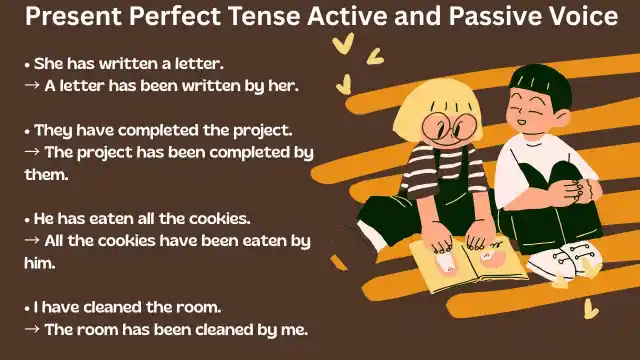
- She has written a letter.
→ A letter has been written by her. - They have completed the project.
→ The project has been completed by them. - He has eaten all the cookies.
→ All the cookies have been eaten by him. - I have cleaned the room.
→ The room has been cleaned by me. - We have solved the problems.
→ The problems have been solved by us. - The manager has approved the proposal.
→ The proposal has been approved by the manager. - She has invited all the guests.
→ All the guests have been invited by her. - They have built a new school.
→ A new school has been built by them. - He has opened the shop.
→ The shop has been opened by him. - The teacher has explained the lesson.
→ The lesson has been explained by the teacher.
Common Mistakes to Avoid
- Confusing “has” and “have”
- Missing “been” in the passive structure
- Changing the main verb instead of keeping it in past participle
Present Perfect Tense Active And Passive Voice Exercise
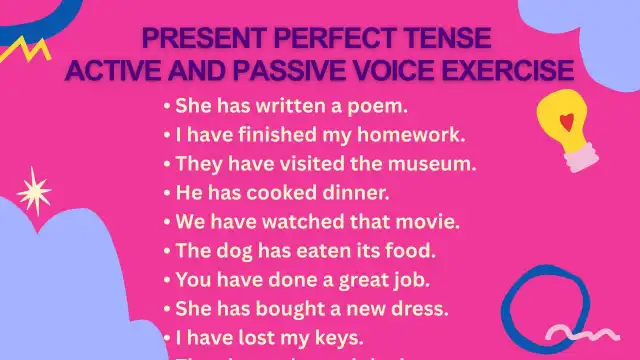
- She has written a poem.
- I have finished my homework.
- They have visited the museum.
- He has cooked dinner.
- We have watched that movie.
- The dog has eaten its food.
- You have done a great job.
- She has bought a new dress.
- I have lost my keys.
- They have cleaned the house.
- He has joined the gym.
- We have planned a surprise.
- She has painted the wall.
- I have read this book before.
- The students have submitted their assignments.
- You have improved your skills.
- He has broken the vase.
- We have taken the test.
- She has gone to the market.
- They have learned a new language.
Answers
- A poem has been written by her.
- My homework has been finished by me.
- The museum has been visited by them.
- Dinner has been cooked by him.
- That movie has been watched by us.
- Its food has been eaten by the dog.
- A great job has been done by you.
- A new dress has been bought by her.
- My keys have been lost by me.
- The house has been cleaned by them.
- The gym has been joined by him.
- A surprise has been planned by us.
- The wall has been painted by her.
- This book has been read by me before.
- The assignments have been submitted by the students.
- Your skills have been improved by you.
- The vase has been broken by him.
- The test has been taken by us.
- The market has been gone to by her.
- A new language has been learned by them.